How Pressure Gauges Help Keep Compressors Running Safely
- Share
- Issue Time
- Aug 27,2026
Summary
Compressors are widely used in manufacturing, workshops, pneumatic systems, refrigeration, and many other industrial applications. Their main function is to increase the pressure of air or gas and deliver it to equipment or storage systems.
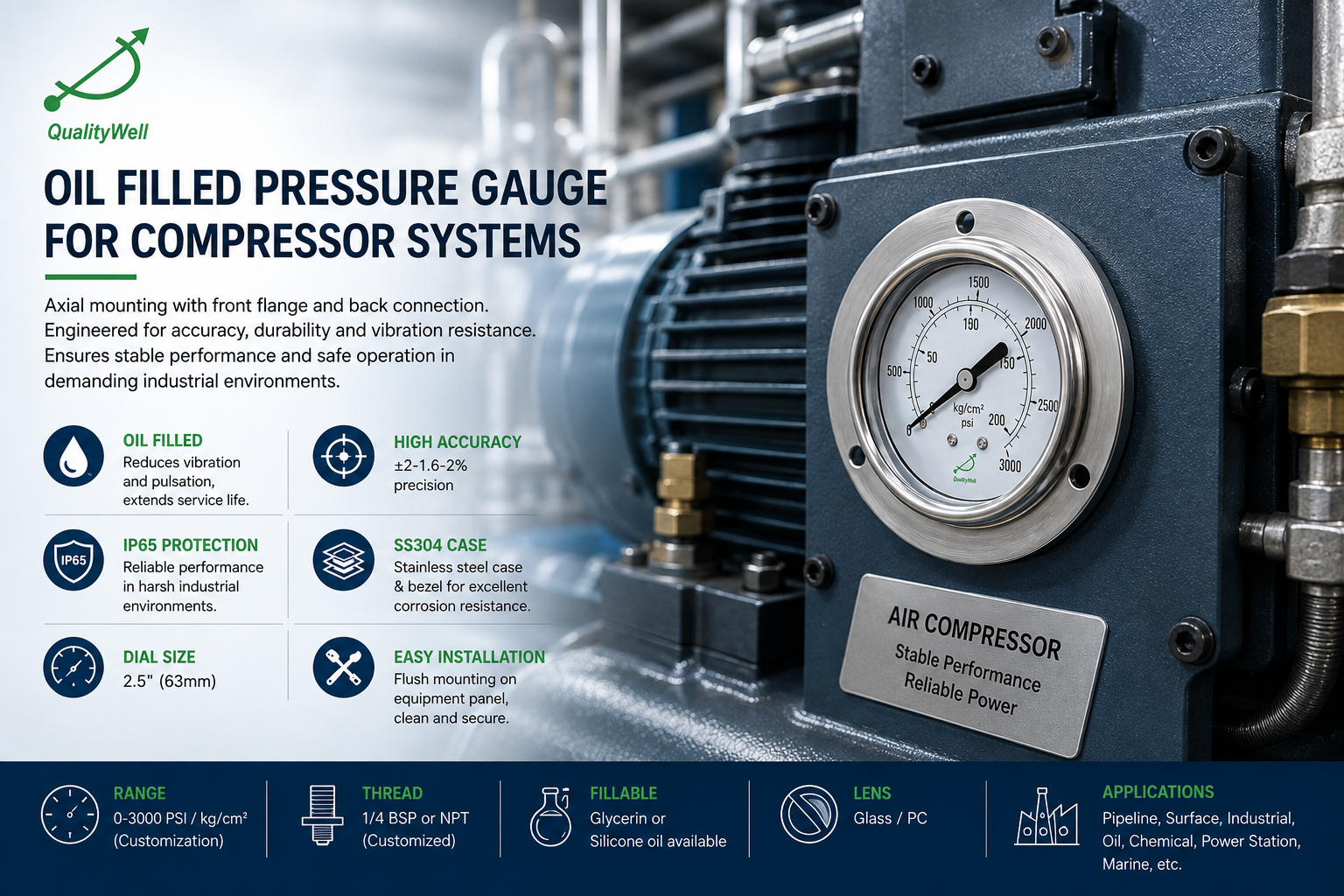
How Pressure Gauges Help Keep Compressors Running Safely
Compressors are widely used in manufacturing, workshops, pneumatic systems, refrigeration, and many other industrial applications. Their main function is to increase the pressure of air or gas and deliver it to equipment or storage systems.
What Is a Compressor?
A compressor converts mechanical energy into pressure energy. An electric motor or engine drives internal components—such as pistons or screws—to compress air by reducing its volume. As the air is compressed, its pressure and temperature increase before it is discharged to an air receiver tank or downstream equipment.
Common types include reciprocating compressors, rotary screw compressors, scroll compressors, and centrifugal compressors.
Why Is a Pressure Gauge Important?
A pressure gauge is an essential instrument in a compressor system. It provides a direct reading of system pressure and helps operators monitor whether the compressor is working within the required range.
A pressure gauge can help:
Monitor compressor output pressure
Check air receiver tank pressure
Identify pressure that is too high or too low
Detect possible leaks or performance problems
Support routine maintenance and troubleshooting
Improve overall system safety
For example, if the compressor cannot reach the required pressure, possible causes may include air leaks, worn components, damaged valves, or a blocked intake filter. If the pressure becomes too high, the pressure control system may need to be inspected.
Choosing the Right Pressure Gauge
When selecting a pressure gauge for a compressor, important factors include the pressure range, dial size, connection type, thread specification, accuracy, material, and operating environment.
Because compressors can generate vibration, a glycerin-filled pressure gauge may also be a suitable option for applications where a more stable pointer reading is required.
Conclusion
Although it is a relatively simple instrument, a pressure gauge plays an important role in compressor performance, maintenance, and safety. Reliable pressure monitoring helps operators understand system conditions and identify potential problems before they become more serious.
Shanghai Qualitywell supplies industrial pressure gauges and supports OEM and customized requirements, including pressure ranges, dial designs, connection types, threads, and branding.